
Blog
1:3 Scale Collectible Replica Guns — The Collector’s Complete Guide

Why 1:3 Scale Collectible Replica Guns Are the Sweet Spot for Serious Collectors
In the world of miniature firearms collecting, scale matters enormously — and no scale has earned more respect among serious hobbyists than 1:3. Sitting precisely between the broad strokes of smaller novelty scales and the unwieldy bulk of half-size replicas, the 1:3 scale hits an extraordinary balance: enough surface area to capture intricate mechanical detail, small enough to display elegantly, and substantial enough to convey the weight and presence of the original firearm.
Whether you’re drawn to the engraved walnut stocks of 19th-century cavalry revolvers, the cold precision of WWII-era military sidearms, or the iconic silhouette of Wild West long arms, the 1:3 scale is where craftsmanship and collectibility converge.
This guide covers everything an experienced collector needs to know — from understanding what separates a great 1:3 replica from a mediocre one, to sourcing, authentication, display, and long-term valuation strategy.
What Is 1:3 Scale? Understanding the Specification
Scale notation in collectibles refers to the ratio of the replica’s dimensions to the original firearm’s dimensions. A 1:3 scale replica is exactly one-third the size of the original in every dimension — length, width, and height.
To put this in concrete terms:
- A Colt Single Action Army revolver with a 7.5-inch barrel becomes approximately 2.5 inches in 1:3 scale
- A Winchester Model 1873 lever-action rifle at 49 inches overall becomes approximately 16.3 inches at 1:3 scale
- A Luger P08 at 8.75 inches becomes just under 3 inches in 1:3 scale
This reduction is significant enough to make pieces highly displayable in standard collector cases, yet generous enough that makers can faithfully reproduce functional mechanisms, barrel rifling patterns, grip checkering, proof marks, and serial number engravings with the same precision found on the originals.
At smaller scales (1:6 or 1:12), this level of mechanical detail becomes difficult or impossible to reproduce accurately. At larger scales (1:2), pieces become cumbersome and expensive to display properly. The 1:3 scale is the industry’s most respected standard for collector-grade miniature replica firearms precisely because it optimizes for both detail fidelity and display practicality.
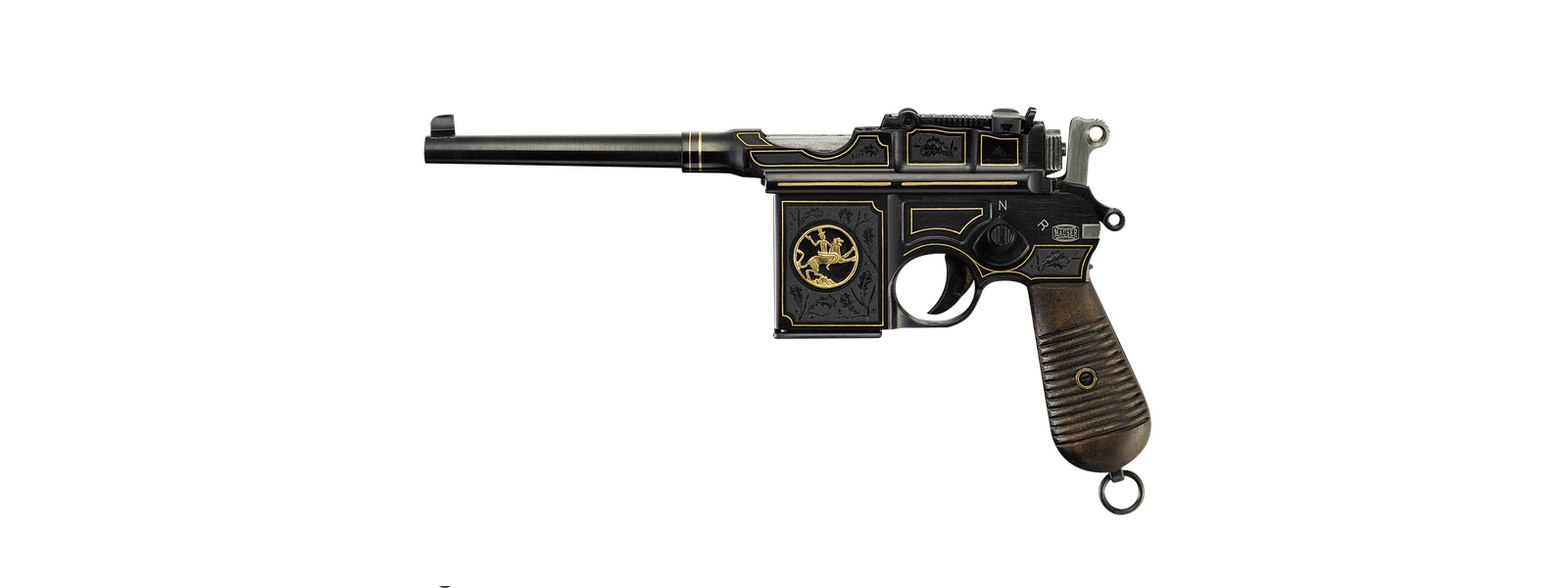
The Anatomy of a Quality 1:3 Scale Replica — What to Look For
Not all 1:3 scale replicas are created equal. The market ranges from mass-produced die-cast novelties retailing under $30 to museum-grade, hand-finished collector pieces commanding several thousand dollars. Knowing what distinguishes them is the foundation of smart collecting.
1. Material and Construction
Collector-grade 1:3 replicas are typically constructed from one or more of the following:
- Solid zinc alloy (Zamak) — the industry standard for die-cast collector replicas; dense, takes fine engraving well, and machines with crisp tolerances
- Steel-alloy machined components — found in premium pieces where specific parts (barrels, cylinders, frames) are CNC-machined for dimensional accuracy
- Genuine wood grip scales — walnut, rosewood, or period-correct hardwoods, hand-fitted and finished
- Precious metal plating — silver, gold, or nickel electroplating on premium and limited-edition runs
What to avoid: Pieces constructed primarily from pot metal (an unstable low-grade zinc alloy), hollow-body construction, or plastic components disguised with metallic paint. These are novelties, not collectibles, and they do not hold or appreciate in value.
2. Mechanical Accuracy
The best 1:3 scale replicas feature functional or semi-functional mechanical actions:
- Revolvers with rotating cylinders
- Semi-automatics with moving slides
- Lever-action rifles with working levers
- Bolt-action rifles with operable bolts
Functional mechanics at 1:3 scale require significantly higher manufacturing precision and are a reliable proxy for overall build quality. If the action works smoothly at one-third scale, the tolerances throughout the piece are almost certainly excellent.
3. Finish Quality and Surface Detail
Run your eye — and if you can, your fingertip — across the piece:
- Engraving lines should be clean, consistent, and deep enough to be visible at the scale; ragged or shallow engraving indicates a lower-quality mold
- Parting lines (the seam where mold halves meet) should be invisible or nearly so on premium pieces; prominent parting lines indicate production-grade rather than collector-grade manufacturing
- Plating uniformity — even coverage with no bubbling, pitting, or thin spots in recessed areas
- Wood grain and finish on grip scales should be hand-applied, not printed or decaled
4. Provenance and Documentation
Every legitimate collector-grade 1:3 scale replica should come with:
- Certificate of Authenticity (COA) with edition number, total run size, and cross-referenceable serial number
- Manufacturer documentation — catalogue reference, production year, and official product description
- Original packaging — box, outer sleeve, polishing cloth, and display stand where applicable
Missing documentation reduces a piece’s collector value by 25–45% and raises legitimate authentication concerns on the secondary market.
The Most Collectible 1:3 Scale Replica Gun Categories
The 1:3 scale collectible replica gun market organizes naturally into several high-demand categories. Here’s where experienced collectors are focusing attention — and capital — in 2025:
American West & Frontier Firearms
The Wild West category consistently commands the strongest collector demand and the most robust secondary market. Key pieces include:
- Colt Single Action Army (“Peacemaker”) — the archetypal frontier revolver, available in cavalry, artillery, and civilian configurations
- Winchester Model 1873 — “The Gun That Won the West,” highly desirable in rifle and carbine variants
- Remington Model 1875 — a refined alternative to the Colt SAA with a distinctive web under the barrel
- Smith & Wesson Schofield — the top-break revolver favored by Wells Fargo and military officers
World War II Military Sidearms
WWII militaria consistently attracts the broadest collector base, with strong crossover interest from military history enthusiasts and veteran family members:
- German Luger P08 — among the most collected WWII-era sidearms globally
- Walther P38 — the Luger’s successor, with a distinctive double-action mechanism
- Colt M1911A1 — the definitive American military sidearm, produced in enormous numbers and variants
- British Webley Mk VI — the heavy, distinctive top-break revolver carried by British officers in both world wars
Historical & Antique Arms
For collectors drawn to pre-cartridge era firearms, 1:3 scale offers extraordinary detail on mechanically complex originals:
- Flintlock pistols — particularly ornate European dueling pistols and military horse pistols
- Percussion cap revolvers — Colt Navy and Army models, Remington New Model Army
- Antique Kentucky/Pennsylvania rifles — long rifles with hand-engraved patchboxes and tiger maple stocks
Modern & Tactical Firearms
A growing category attracting younger collectors with military and law enforcement backgrounds:
- Desert Eagle .50 AE — the most recognizable modern large-caliber semi-automatic
- SIG Sauer P226/P229 — standard issue across numerous international military and law enforcement agencies
- HK MP5 — the iconic submachine gun, extensively detailed at 1:3 scale
Where to Buy Authentic 1:3 Scale Collectible Replica Guns
Sourcing is where many collectors lose money — through overpaying at retail, buying misrepresented pieces on secondary markets, or missing access to limited releases. A multi-channel sourcing strategy is essential.
Specialty Collector Retailers (Primary Market)
The safest and most reliable source for authenticated, new-in-box 1:3 scale replicas is a dedicated specialty retailer with direct manufacturer relationships and documented authentication practices.
At Miniature Arsenal, our curated inventory is sourced directly from the world’s leading replica firearms manufacturers, with every piece accompanied by full documentation, verified COAs, and condition grading. Our specialist team vets each piece before it reaches our catalogue — so you’re never buying blind.
Browse our full range of 1:3 scale collectible replica guns at Miniature Arsenal — including limited-edition releases, precious-metal-finished pieces, and historically significant models across every major era and category.
Auction Houses (Secondary Market)
For rare, discontinued, or estate-sourced pieces, major auction houses are the gold standard:
- Rock Island Auction Company — the world’s largest firearms auction house, with dedicated catalogue sales for collectible and antique arms including miniature replicas
- Heritage Auctions — strong militaria and collectibles department with searchable past-sale price records, invaluable for market valuation
Collector Communities and Shows
The Antique Arms Show held annually in Las Vegas is the premier in-person marketplace for serious arms collectors — an essential annual event for networking, sourcing, and authentication consultation with recognized specialists.
Authentication: How to Verify a 1:3 Scale Replica Before You Buy
The secondary market for 1:3 scale replica guns has meaningful counterfeit and misrepresentation risk. Apply this authentication checklist to every secondary market acquisition:
The Five-Point Authentication Check
① Maker’s Mark Verification Every legitimate manufacturer stamps or engraves identifying marks on their pieces — typically on the frame underside, barrel flat, or grip tang. Cross-reference against the manufacturer’s documented mark library. Unknown or inconsistent marks are an immediate red flag.
② Weight and Density Test Collector-grade zinc alloy and steel-alloy pieces have a characteristic heft. At 1:3 scale, a quality revolver replica should weigh between 180–340 grams depending on size. Pieces that feel suspiciously light (hollow body or pot metal) should be assessed very carefully.
③ COA Serial Number Cross-Reference Request the COA and cross-reference the serial number with the manufacturer’s collector services department. Most major manufacturers (Denix, Franklin Mint, Umarex) maintain serial number verification services.
④ Edition Number Consistency The edition number engraved on the piece (e.g., “247/500”) should match the COA exactly. Mismatches indicate the COA and piece were separated and incorrectly paired — a common secondary market problem.
⑤ Finish and Parting Line Assessment Under a 10x loupe, inspect the engraving quality and parting lines. Authentic collector pieces show clean, consistent engraving. Counterfeits typically show casting artifacts, rough engraving, and visible parting seams.
Displaying Your 1:3 Scale Collection Professionally
A great collection deserves a display system worthy of its quality. At 1:3 scale, pieces are large enough to be visually impactful and small enough to build impressive groupings without requiring dedicated room space.
Display Case Recommendations
- UV-filtering acrylic or glass cases — essential; UV exposure degrades metal finishes, wood patina, and plating over 12–24 months of direct or indirect sunlight exposure. The Smithsonian Museum Conservation Institute’s guidelines on preventive conservation recommend UV filtering for all metal artifact display — the same standard applies to your collection
- Individual acrylic risers or weapon stands — elevate pieces off the case floor for 360° visibility without handling
- Grouping by theme or era — thematic groupings (all WWII sidearms, all frontier revolvers) create visual narrative and make the collection more impressive to guests and appraisers alike
Environmental Controls
- Relative humidity: 45–55% — use a digital hygrometer and a small dehumidifier or humidifier to maintain stability
- Temperature: 65–70°F (18–21°C) stable — avoid exterior walls and rooms with large temperature swings
- Air quality: Avoid display in rooms with wood-burning fireplaces, heavy cooking, or industrial proximity — airborne particulates accelerate oxidation on metal finishes
Valuation and Investment Outlook for 1:3 Scale Replica Guns
The 1:3 scale collectible replica gun market has demonstrated consistent long-term value retention and selective appreciation, particularly for limited-edition and precious-metal-finished pieces from recognized manufacturers.
Key Value Drivers
| Factor | Impact on Value |
|---|---|
| Edition size under 500 | High — scarcity premium of 40–120% over open editions |
| Precious metal finish (silver/gold) | High — intrinsic material value plus collector premium |
| Mint-in-Box with full documentation | Significant — 30–50% premium over undocumented pieces |
| Historical anniversary relevance | Moderate-High — anniversary editions appreciate on release date milestones |
| Maker prestige (Franklin Mint, Denix) | Moderate — brand recognition supports secondary market liquidity |
| Original packaging present | Moderate — 25–40% premium vs. pieces without original box |
Insurance and Appraisal
Any collection with a total replacement value exceeding $2,500 should carry a dedicated collectibles insurance policy. Standard homeowner’s policies cap collectibles at $1,000–$2,500 with significant exclusions. Specialist insurers including Collectibles Insurance Services offer agreed-value policies covering theft, accidental breakage, and transit — typically at $1–$2 per $100 of insured value annually, with no deductible on many plans.
For formal appraisal, seek a USPAP-certified personal property appraiser with documented militaria or collectible arms specialization. Major auction houses also offer complimentary appraisal consultations for pieces they may carry in future catalogue sales.
Frequently Asked Questions
Q: Are 1:3 scale replica guns legal to own? A: In most jurisdictions, non-firing scale replica firearms are entirely legal to own, display, and collect. They are not classified as firearms under most national and state/provincial regulations because they are neither functional nor readily convertible. However, import regulations vary by country — always verify customs rules before international purchases, particularly regarding realistic-appearance replica regulations in the UK, Australia, and Canada.
Q: What is the difference between 1:3 scale and 1:2 scale replica guns? A: A 1:3 scale replica is one-third the size of the original firearm; a 1:2 scale replica is one-half the size. The 1:2 scale produces larger, heavier pieces with somewhat more surface area for detail, but at significantly higher production cost and display space requirement. The 1:3 scale is the preferred collector standard because it optimizes detail fidelity, displayability, and price accessibility simultaneously.
Q: How do I clean and maintain a 1:3 scale metal replica gun? A: Use a soft, lint-free microfiber cloth for regular dusting. For metal surfaces, a light application of Renaissance Wax (the museum conservation standard) applied with a soft cloth and buffed off provides long-term oxidation protection without altering the finish. Avoid spray cleaners, solvents, or abrasive cloths. Wooden grip scales can be treated annually with a small amount of lemon oil applied with a cotton swab.
Q: What is the most valuable 1:3 scale replica gun category? A: Limited-edition, precious-metal-finished pieces from recognized manufacturers in the American West and WWII categories consistently achieve the highest secondary market values. Sub-250 edition runs in sterling silver finish from Franklin Mint or comparable studios have sold at 200–400% of original retail at major auction houses.
Q: Where can I find discontinued or rare 1:3 scale replica guns? A: Rock Island Auction Company, Heritage Auctions, and estate sale networks are the best secondary market sources. Collector communities on platforms like The Firearms Forum and dedicated militaria Facebook groups also surface rare pieces through private sales, often at more favorable prices than auction.
The Bottom Line
The 1:3 scale is not simply a size specification — it’s a philosophy of collecting. It says: I want the full story of this firearm, rendered with complete fidelity, in a form I can display, study, and pass on.
For experienced collectors who understand what separates a piece worth owning from one merely worth glancing at, the 1:3 scale collectible replica gun market in 2025 offers extraordinary depth — historically, aesthetically, and in terms of long-term collectible value.
Start or expand your collection today — explore our fully authenticated, curated range of 1:3 scale collectible replica guns at Miniature Arsenal and find the piece that belongs in your collection.
Published by Miniature Arsenal | Collectibles / Hobbies / Specialty Category: Collecting Guides | Tags: 1:3 scale collectible replica guns, miniature replica firearms, scale model guns for collectors, collectible replica weapons, miniature arsenal collection, replica gun display, miniature firearms authentication